

- You’ve tried AI for writing. It gave you something generic, off-voice, and maybe even made up facts that never happened.
- You’ve heard the hype. Productivity gains. Time savings. Competitive advantage. But when you tried it yourself, you wondered what you were missing.
- You’ve written it off. “AI isn’t for me” or “Maybe in a few years when it’s better.”
If any of those describe you, here’s what you’re missing.
You reached for the wrong tool.

The Hammer Problem
Working with business leaders on AI adoption, I’ve noticed a pattern. Most people start in the same place. They ask AI to write something. An email. A blog post. A social media caption. Marketing copy.
And most people get similar results. Generic. Lifeless. Sometimes factually wrong. Definitely not their voice.
So they conclude AI doesn’t work. Or it’s not ready yet. Or it’s fine for other people but not for the kind of work they do.
What if the issue isn’t AI itself? What if it’s approaching AI as a single tool when it’s actually a toolbox?
There’s an old saying often attributed to Abraham Maslow: if all you have is a hammer, everything looks like a nail. What happens when people approach AI with one hammer—content generation—and wonder why it can’t do finish carpentry?
AI is not a tool. It’s a toolbox with at least four distinct tools. And picking the right one for the job makes all the difference.
Four Tools You Didn’t Know You Had
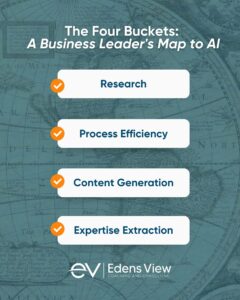
After months of experimentation, failure, learning, and finally some real wins, I’ve come to see AI capabilities in four buckets. Each bucket serves a different purpose. Each requires a different approach. And each produces different results.
- Bucket 1: Research — synthesizing information from hundreds of sources
- Bucket 2: Process Efficiency — automating what you already do
- Bucket 3: Content Generation — creating written content in your voice
- Bucket 4: Expertise Extraction — mining knowledge you didn’t know you had
What would it mean for your work if you knew which tool to reach for? What if choosing the right bucket could solve problems you’ve struggled with for months? I’ll walk you through each one; what it does, when to use it, and what it looks like in practice.
Bucket 1: Research — The Hidden Gem
This is the bucket most people don’t even know exists.
Yes, Google has added AI features to search. But using a dedicated AI tool in research mode is another level entirely. Have you experienced the difference between skimming headlines and having a research assistant synthesize hundreds of sources into a coherent answer?
A simple example from my own life.
Last Christmas, I received a new car radio as a gift. Nice upgrade. One problem: phone calls had a persistent echo. People couldn’t hear me without a headset. For nearly a year, I worked around it. Did Google searches. Found nothing useful. Assumed I’d eventually buy an external microphone and hope for the best.
Then I tried AI research mode.
I described the radio, the symptoms, and the problem. I asked for solutions that had actually worked for other people. What would normally take hours of forum-diving happened in twenty minutes. I had a five-page report synthesizing over 600 internet sources.
The surprising finding? An external microphone wouldn’t fix it. The radio had an internal circuitry issue that keeps the built-in mics active even when an external one is plugged in. No forum post I’d found on Google mentioned this. But AI found it buried in technical discussions across multiple platforms; including which specific models on Amazon to avoid and which ones might actually work.
Twenty minutes. Six hundred sources. A year of frustration resolved.
That’s the research bucket. Not asking AI to fabricate information. Asking it to find, synthesize, and summarize what’s already out there; faster and more thoroughly than you could do yourself.
When would you use this? Anytime you’re gathering information before making a decision. Market research. Competitive analysis. Technical troubleshooting. Understanding a new industry. Preparing for a difficult conversation.
What decisions are you facing right now that would benefit from deeper research? What questions have been sitting on your someday list because the research feels overwhelming? What would become possible if you could access 600 sources in twenty minutes instead of spending weeks trying to piece it together yourself?
Bucket 2: Process Efficiency — Automate What You Already Do
This bucket isn’t about adding new capabilities. It’s about doing existing things faster, more consistently, and with less cognitive load.
The best entry point? Something you already do repeatedly that takes more time than it should. What tasks drain your energy week after week? Where do you feel the friction of repetition? What would you do with an extra three hours every week?
For me, that was coaching session notes.
Before I discovered this bucket, I took notes manually during and immediately after each Zoom call. I was concerned about forgetting important details, so I split my attention between listening deeply and capturing everything. Neither happened well. Have you ever tried to be fully present with someone while simultaneously documenting the conversation? How did that work for you?
In early 2025, I tried a vertical market AI tool designed for coaches. It was… okay. It transcribed and summarized. But it didn’t grow to understand my context. Each session seemed to start from zero. No memory of the client’s history. No understanding of my frameworks. Just generic output that required heavy editing.
Now the workflow runs almost automatically. Zoom recording becomes transcript. Transcript gets anonymized. Content formats for our coaching software. Session notes export as HTML and paste directly into our client management system.
My assistant Carissa estimates this saves three hours per week. At her rate, that’s roughly $100 weekly; over $5,000 per year from one workflow improvement.
But what excites me more than the time savings is what happened next. Carissa took ownership of the system. She didn’t just run my prompts; she improved them. She connected the workflow to ClickUp so it auto-generates tasks and subtasks with due dates. She made it hers.
That’s what I find most valuable about the process efficiency bucket. You’re not replacing human judgment. You’re freeing human creativity to focus on higher-value work.
Where do you have repetitive tasks that drain time and mental energy? What would it mean to get those hours back? What could you create, build, or develop if the administrative burden lifted? And what would it look like if the people on your team took ownership of the systems instead of just following instructions?
Bucket 3: Content Generation — Where Everyone Starts and Most Fail
The uncomfortable truth: this bucket is both the most popular and the most likely to disappoint.
I know because I’ve been there.
In late 2024 and early 2025, I tried multiple times to use free AI tools for writing. The results consistently disappointed me. Generic phrasing that could have come from anyone. Facts that sounded plausible but never actually happened. And a voice that sounded nothing like me.
If I’d stopped there, I would have concluded AI wasn’t ready for real work. Many leaders do exactly that. They try content generation first, get poor results, and assume the whole toolbox is broken. Have you had that experience? Did it shape how you think about AI now?
The gap isn’t AI capability. It’s context.
Most people approach content generation like ordering from a menu. “Write me a blog post about productivity.” “Draft an email to my team about the new policy.” “Create social media captions for this product launch.”
Generic input produces generic output. Every time.
Cal Newport, author of Deep Work and Slow Productivity, has written extensively about the knowledge work crisis. In Deep Work, he argues:
“The ability to perform deep work is becoming increasingly rare at exactly the same time it is becoming increasingly valuable in our economy. As a consequence, the few who cultivate this skill, and then make it the core of their working life, will thrive. Deep work is so important that we might consider it the superpower of the 21st century.”
What does this have to do with AI? AI trained on the internet has absorbed millions of examples of shallow, interchangeable content. Ask it to write without context, and it gives you the average of everything it’s seen. It produces what Newport would call “shallow work” at scale.
Your voice isn’t average. Your perspective isn’t generic. Your expertise isn’t interchangeable.
So why would you expect AI to capture those things without showing it who you are?
The leaders who succeed with content generation don’t just write prompts. They provide context. They feed AI their previous writing. They share their frameworks, their client stories, their unique point of view. They treat AI like a collaborator who needs onboarding, not a vending machine that dispenses content on demand.
Does this take more work upfront? Yes. Is it worth it? Ask anyone who’s built a system that actually sounds like them. What would it mean for your work if AI could genuinely capture your voice? What context would you need to provide? And what could you create if you had a collaborator who understood your frameworks, your audience, and your perspective?
If content generation hasn’t worked for you, that doesn’t mean AI won’t work for you. You’ve discovered that this particular tool requires more setup than the others. What if you started with Bucket 1 or 2 instead? What if you built familiarity with how AI thinks before expecting it to write in your voice?
Consider starting with research or process efficiency. Build familiarity with how AI thinks. Then return to content generation with realistic expectations and proper context.
Bucket 4: Expertise Extraction — Mining What You Already Know
This is the bucket that shifted how I think about AI. And it’s probably the least intuitive.
Most people use AI to get answers. Expertise extraction flips that. You use AI to ask you questions; and in doing so, extract knowledge you didn’t even know you had.
How did I discover this?
It was the Sunday after Thanksgiving. I was driving to a business conference; supposed to be a four-and-a-half-hour trip that turned into six-and-a-half hours thanks to traffic. Normally I’d use drive time to consume content. Podcasts. Audiobooks. Maybe some music to decompress. What do you typically do with unexpected time like that?
Instead, I opened AI and started working on a newsletter article. The topic: how business owners can protect time for deep work and actually use that time instead of letting it slip away to urgent demands.
As the article developed, AI generated some downloadable tools to support the concepts. And I started thinking: is there enough here for more than an article? Could this be an e-book? An e-course?
Then something shifted.
Instead of asking AI to build out the course, I asked it to help me figure out whether there was really enough material. I said: “What questions would you like to ask me? Please ask them one at a time.”
Sixteen questions later, I had my answer. Yes, there was enough.
But more than that; the questions had drawn out insights I hadn’t consciously articulated. Frameworks I use with clients but have never named. Objections people raise and the real fears beneath them. Patterns I’d observed across dozens of coaching conversations but never written down.
By the end of the drive, AI had generated outlines for 13 downloadable PDF assets based purely on my answers to its questions.
The irony? I was creating content about protecting deep work time while using drive time I would have written off as unproductive. Traffic that would normally frustrate me became surprisingly productive.
That’s expertise extraction. Not asking AI to think for you; asking AI to help you articulate what you already know.
What invisible knowledge do you carry that you’ve never put into words? What would happen if someone asked you the right questions? What frameworks do you use so naturally you don’t even notice them anymore?
If you’re a coach, consultant, or expert in any field, you have invisible expertise; insights so embedded in how you work that you don’t even notice them anymore. AI can help surface that knowledge, structure it, and turn it into assets you can share, teach, or sell.
What could you create if someone interviewed you about your methodology? What would emerge if AI spent an hour asking you questions about how you actually work?
Where Most Leaders Should Begin

My advice: start anywhere except Bucket 3.
Content generation requires the most context and setup. It’s where expectations run highest and disappointment is most common. If you begin there and struggle, you’ll likely give up on the whole toolbox. Does that pattern sound familiar?
Instead, consider matching the bucket to your situation using what I call the Three R’s of AI Entry:
Research — If you make decisions that require information gathering Routine — If you’re drowning in repetitive tasks Revelation — If you’re sitting on years of invisible knowledge
Let me break those down:
If you’re drowning in repetitive tasks, start with Process Efficiency (Routine). Find one workflow you do weekly and experiment with automating pieces of it. The ROI is immediate and measurable. What task did you do this week that felt like a waste of your time? What would you do with those hours back?
If you make decisions that require information gathering, start with Research. Pick a question you’ve been meaning to dig into and see what AI research mode can find that Google couldn’t. What question has been sitting on your list because the research feels daunting? What decision are you putting off because you don’t have enough information?
If you’re a coach, consultant, or expert sitting on years of invisible knowledge, start with Expertise Extraction (Revelation). Ask AI to interview you about your methodology. You might be surprised what emerges. What do clients thank you for that you’ve never formally taught? What insights do you share casually that could be structured into frameworks?
And when you’re ready for Content Generation, approach it with patience, context, and realistic expectations. It’s a powerful bucket for scaling your voice; but only after you’ve taught AI who you are.
The toolbox is there. The question is which tool you’ll pick up first.
Your First Week: Practical Starting Points
Ready to experiment? Here’s a simple framework for each bucket:
If Starting with Research:
- Choose one decision you’re facing this week
- Write down the core question you need answered
- Spend 20 minutes in AI research mode
- Compare what you find to a traditional Google search
- Ask yourself: What did AI surface that I would have missed?
If Starting with Process Efficiency:
- Pick your most repetitive weekly task
- Time how long it currently takes
- Describe the task to AI in detail (inputs, outputs, steps)
- Ask AI to suggest automation options
- Test one option this week and track time saved
If Starting with Content Generation:
- Don’t start here unless you’ve tried Bucket 1 or 2 first
- If ready: Share 3-5 examples of your previous writing with AI
- Describe your voice, audience, and perspective
- Ask AI to analyze your voice patterns
- Request a draft and expect to revise heavily
If Starting with Expertise Extraction:
- Block 30 minutes of uninterrupted time
- Tell AI: “Interview me about [your methodology/expertise area]”
- Add: “Ask me questions one at a time”
- Answer honestly; don’t overthink
- Review what emerged and look for patterns
The goal isn’t perfection. It’s experimentation. What worked? What didn’t? What surprised you?
For Reflection
Before you close this tab and move on, take three minutes with these questions:
- Which bucket have you spent the most time in?
Has that been the right bucket for your actual needs? What drew you to that bucket first? And what would shift if you chose differently?
- Looking at your current frustrations—repetitive tasks, information gaps, content demands, invisible expertise—which bucket addresses your most pressing pain point?
What would solving that pain point make possible? What’s currently blocked because this problem hasn’t been solved?
- What’s one experiment you could run this week in a bucket you haven’t tried before?
What would success look like? And what would you learn even if the experiment failed?
Write down your answers. Not mentally. Actually write them.
What Will You Try?
In Article 1 of this series, I argued that AI is neither Satan nor Savior. It’s a tool to be used with discernment.
Now you know it’s not just one tool. It’s a toolbox with four distinct instruments.
This is a practical decision, not a spiritual one—though the wisdom of choosing well applies to both. Whether you approach this from a place of faith or purely from business pragmatism, the principle remains: match the tool to the task.
Remember the hammer problem? Most leaders grab the content generation hammer first. They swing at everything. Writing. Strategy. Research. Process. When it doesn’t work, they put the whole toolbox away.
But you’re not most leaders. You now know what’s actually in the toolbox:
- Research for information synthesis
- Process Efficiency for workflow automation
- Content Generation for voice at scale
- Expertise Extraction for invisible knowledge
The question isn’t whether AI works. The question is whether you’re reaching for the right tool.
The leaders who get the most from AI won’t be the ones who master every feature. They’ll be the ones who learn to match the tool to the task. Who open the toolbox, examine what’s inside, and choose wisely.
That’s wisdom. And it’s available to you right now.
Your Next Step
If you’re ready to move from “should I?” to “how wisely?”; I’m hosting a webinar on using AI as a leader without losing your voice.
We’ll cover how to engage with discernment, maintain your authentic perspective, and use AI as a tool that amplifies your expertise rather than replacing it.
No hype. No fear. Just practical wisdom for leaders who want to engage thoughtfully.
I’ll see you there.
David Limiero is the founder of Edens View Coaching and Consulting, helping overwhelmed leaders move from overwhelm to overflow.