

This article is for you if:
- You wake at 3 a.m. with that gnawing feeling. Something’s undone. You can’t name it.
- Your email has become your task manager. Threads multiply. Clarity disappears.
- You’ve built systems that work beautifully. Until external pressures disrupt your rhythm.
The Thing About Ambient Angst
David Allen coined a phrase in Getting Things Done that perfectly captures a feeling most leaders know too well. He calls it “ambient angst.”
Here’s how Allen describes it:
“It’s that vague sense of unease that pervades your consciousness when you have too many undecided things in your psyche. There’s a sense that there’s something you need to do or something you’ve left undone, what I call an ‘open loop,’ but you’re not exactly sure what those things are. Because there’s a lack of clarity about what exactly needs to happen, there’s this underlying anxiety. And it’s ambient because it’s just kind of there, all around you—when you’re trying to go to bed, when you have a quiet moment and your brain slows down, when the immediate work pressure lifts. It’s the psychological tax of mental clutter, the accumulated weight of decisions not made and actions not defined.”
That’s the way I used to live my life.
A Vulnerable Confession
But early last week surprised me. That vague sense of unease started showing up again. The open loops Allen describes began multiplying in my mind. Things I couldn’t quite name kept nagging at me when I tried to focus. That familiar background hum of anxiety returned.
After decades of building systems, rhythms, and structures specifically designed to eliminate this exact problem, I found myself on Monday morning recognizing that ambient angst had escalated into something more acute: I was on the edge of overwhelm.
That’s a humbling admission for a coach whose entire methodology centers on helping leaders live and lead from overflow instead of overwhelm. What kind of coach gets overwhelmed?
Apparently, this one.

When External Complexity Meets Internal Systems
I met with our executive assistant Carissa for our regular Monday admin meeting. I took that vulnerability a level deeper and confessed what I was feeling. Then I began identifying the source.
We were working for the first time with two major external clients and one vendor. All three managed tasks and projects almost exclusively through email. One email thread had eighty-one messages. Others were building to thirty or forty.
Files. Attachments. Reply-alls. Individual replies. Cluttered and overwhelming.
Our internal system works beautifully; neither Carissa nor I feel ambient angst about our internal projects. We know where the balls are and how to juggle them with peace and productivity.
But these external clients? They were creating the opposite effect.
The Genius of the AND
We realized something important on Monday morning. The likelihood of external vendors plugging into our systems was essentially zero; it would be unreasonable to expect them to work in our methodology.
And yet.
We also needed a way to track not only what we were doing, but what everyone else was supposed to be doing. We couldn’t just let confusion reign because “the client would never use our system.”
Notice the tension here. This is what Jim Collins calls in Built to Last “The Genius of the AND.” You need both respect for external partners’ workflows AND internal clarity for your team. Not either-or. Both-and.
But on Monday, we didn’t yet know how to achieve that. So the ambient angst continued.
The Room-by-Room Strategy
Later that week, I met with my coach Carla. She’s been coaching me long enough to recognize when something’s atypical. Through a series of great questions, she led me to a powerful metaphor.
What if I thought about these four discrete projects like rooms in a house?
What if I spent time room by room, cleaning up the clutter in each space? Then I’d at least have clarity on one room before moving to the next. She was teaching me triage: which rooms needed cleaning first, which could be delayed, which were urgent by week’s end.
I also realized something else. When I’m overwhelmed, my physical office space becomes cluttered. Papers pile up; mail goes unanswered. Things sit on my desk meaning to be dealt with but not yet properly addressed.
Physical clutter mirrors mental clutter.
So I spent thirty minutes straightening and cleaning. It felt great to work in a clean space. But the projects? Still there. Still unclear.
When AI Adds to the Confusion
Thursday brought a major strategic planning event I was leading. We’d built most of the framework in Claude, the AI tool we use for such work. But the client’s circumstances had changed; we needed to significantly revise our deliverables and agenda.
Should have taken one hour. Simple adjustments; human double-check; resubmit to client; move forward.
Instead, AI was misbehaving. Things that should have gone simply got stuck. Five hours later, I finally had the clarity I’d hoped would take thirty minutes.
I ended Thursday encouraged by Carla’s coaching and the room-by-room strategy. But frustrated and behind. The client meeting was Friday morning.
How was I going to clean up this first room with so little time?
The Friday Morning Slowdown
I did my workday shutdown ritual Thursday evening. Spent time with my wife. Went to bed at my normal time. Woke early Friday for my morning reflection.
And I realized something critical. What was happening internally was a result of what was happening externally.
In my journal, I recognized I needed to slow my internal pace. That meant no work until 9 a.m. This was different from my normal rhythm; usually I’m up at five for an hour of journaling, prayer, and Bible reading in my quiet space with good coffee and a water candle. Analog time in my dedicated reflection chair.
Then I typically switch to taking advantage of those quiet morning hours between seven and nine for significant work.
But Friday demanded something different. We had the client meeting at ten. I needed to slow my motor down.
Radical Presence as Preparation
So I focused on each discrete task. Shaving and showering and dressing. Making my pour-over coffee—just making coffee, not multitasking. Cooking breakfast. Eating breakfast without pulling out my phone or tablet.
Being present with Jan over breakfast instead of physically there but mentally elsewhere.
What if the solution to overwhelm wasn’t working faster, but slowing down?
I finally arrived at my desk. Turned on my computer. Opened our project management system.
Nineteen notifications. Not there yesterday. Entered by Carissa.
Not particularly excited about nineteen more tasks. But at the top of our one-on-one chat sat a simple message: “Before you look at those nineteen tasks, I’ve made a video for you. I want you to watch it.”
The Dashboard Solution
The nine-minute video showed Carissa’s work. She’d taken those four confusing projects and created a system for assigning owners through a custom field. External clients didn’t need to enter our system; we could manage their responsibilities in a simple visual format.
She’d entered not only upcoming tasks but tasks already completed. We now had a complete project overview. More than that, she’d created dashboards for all four projects so we could see at a glance exactly where we stood.
My angst disappeared.
From Angst to Clarity: The Four Elements
I now had what I call confident clarity. Let me break down what created that transformation:
- Clear Visibility: Tasks, deadlines, owners laid out visually across four project dashboards.
- Calm Confidence: Knowing we had adequate time and space to go room by room, project by project, client by client.
- Collaborative Capacity: My vulnerability had empowered Carissa to invest two hours working on the business, not just in the business.
- Complete Communication: The ability to share responsibilities and capture changes with clarity.
Notice what solved the problem. Not working harder. Not working faster. But vulnerability plus systems plus slowness.
The Mastermind Celebration
Later that day, I met with my business mastermind. We start with wins and celebrations. I shared this journey from ambient angst to confident clarity.
The group saw what I was seeing. Having the right person on your team plus being vulnerable enough to ask for help creates transformation. Carissa needed that confident clarity too; her two-hour investment served both of us.
I recognize the substantial difference in my mental and emotional states. The clarity on what needs to be done, when, and by whom. The ability to disconnect and be present at home with my wife, my children, my grandchildren.
I hate ambient angst. I love confident clarity.
As a coach who teaches people to lead from overflow, even I can be overwhelmed. The solution isn’t working harder or faster; it’s slowing down with the right systems that support that slowness.
Slow down to speed up.
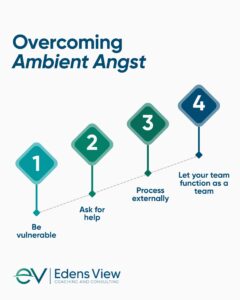
The Pattern for Next Time
Next time I feel ambient angst, the same pattern needs to apply:
Be vulnerable. Be authentic. Name what’s happening.
Ask for help. From your team. From your coach. From your mastermind.
Process externally. Get it out of the monkey mind running circles in your head.
Let your team function as a team. The skills you don’t have are someone else’s favorite thing.
Questions for Your Own Reflection
Where are you facing ambient angst right now? What specific open loops are creating that vague sense of unease?
What would need to happen for you to experience confident clarity? Can you name the specific elements?
Where do you need to be authentic and vulnerable about your overwhelm? With whom—your team, your mastermind, your coach?
How will processing externally with others get you out of your head and into action?
Look around your workspace right now. What physical clutter do you see? How is that physical clutter symbolic of your mental clutter?
Where do you need to create clean physical spaces so you can create clean mental spaces?
Where are you letting challenges stop you from building systems that work? Are you saying “the client would never use our system” when you should be asking “how can we manage this internally”?
Most importantly: When are you taking time to slow down instead of speed up so you can focus on what matters most?
This Is Why I Coach
This journey from overwhelm back to overflow reminded me why I do this work. Nearly every leader I coach faces some version of this pattern. External complexity disrupts internal systems. Ambient angst creeps in. The instinct is to work harder and faster.
But the solution is almost always the opposite. Slow down. Build systems. Be vulnerable. Let your team do what they do best.
If you’re experiencing your own version of ambient angst right now, reach out. Sometimes the perspective of someone who’s been there makes a difference.
Because confident clarity isn’t a luxury for leaders. It’s essential.
With Anticipation,
David
Later this year we’ll be unveiling the Architecture of Transformation™. It starts with what we call Courageous Confession™, which is what I shared with Carissa and Carla. It results in Confident Clarity™. Not just clarity about what to do, but the confidence to actually do it. I can’t wait to share more about this with you soon!
Resources for Your Journey:
- Getting Things Done by David Allen – The definitive guide to managing open loops
- Built to Last by Jim Collins – Understanding “The Genius of the AND”
- Full Focus Planner – The tool I use for daily and weekly planning