

- You’ve tried AI for content. The results were generic, off-voice, maybe even made up facts that never happened.
- You’ve written it off. “AI doesn’t get me” or “It’s not ready yet.”
- You’ve wondered if you’re missing something — but you’re not sure what.
What if you’re not missing something about AI? What if you’re missing something about yourself?
I was in all three places. Until a photographer who’d shot Prince Charles showed me what I was doing wrong.

The Forum Post That Humbled Me
I thought I was ahead of the game.
I’d been using a tool called Castmagic to process my coaching sessions. Import a Zoom recording, generate a transcript, run prompts against it, produce session notes. It worked for me. I felt good about it.
So when someone in a private CoachAccountable forum asked how people were using AI, I shared my workflow. Would others find it as useful as I did? Would they have questions? I expected validation; instead, I got Louise.
Louise Beattie spent 15 years at sea in the oil industry coordinating multi-million dollar subsea construction projects.
Then she reinvented herself as a photographer: commissioned to photograph Prince Charles, shot world championship motorcycle racer Scott Redding twice, and presented business masterclasses at Europe’s largest photography convention, the SWPP. Now she helps solopreneurs build independent incomes through her company Forge & Flourish, having served over 3,200 clients.
Her response to my forum post was generous. She validated Castmagic. She shared her own experience with it. And then she opened a door I didn’t know existed:
“Recently I have been through a program with Max Bernstein called Signal > Noise. It was the first iteration, and he changed it from a cohort to 1-1 to ensure that we received the most from it and to improve it. He has massively over delivered… The objective is to be able to deeply analyse your transcripts and other sources to extract your IP, repeating patterns and much more so that you can systemise your IP. Essentially it helps you extract the knowledge in your head that you use instinctively and turn it into systems… The patterns I am now seeing across multiple clients and calls, not just in the challenges my clients face, but how I respond and help them has been astounding.”
She wasn’t criticizing what I was doing. She was showing me there was another level.
What would I have missed if I’d scrolled past her response? What doors stay closed because we think we’re already far enough along? How many times have you dismissed someone’s suggestion because you thought you already knew enough?
I emailed her immediately and asked for a meeting.
The One-Week Wake-Up Call
What makes this story uncomfortable to tell?
I’d just spent six months building a content bank. Handwritten articles. Carefully crafted. Enough to post consistently for months. We’d been publishing for exactly one week when I saw Louise’s forum response.
One week.
I met with Louise and watched her use AI to generate newsletter and blog content. The speed was different. The depth was different. The integration with her actual expertise was different.
I could have felt like I’d wasted those six months. Did I? No.
I discovered: I’d concluded “I’m already a content creator” a year earlier, after decades of composing weekly sermons. I wasn’t starting from zero. Those six months weren’t wasted time; they were foundation-building time.
AI wasn’t going to replace that; it was going to accelerate what I’d already developed. But only if I learned how to use it properly. Was I willing to be a beginner again?
Was It Worth the Investment?
I reached out to Max Bernstein directly. Max is the creator of Signal > Noise, a methodology for making invisible expertise visible. His core insight is what he calls the Expertise Paradox: “The more masterful you become, the more invisible your mastery becomes… even to you.”
He asked me to send my main website URL and three anonymized coaching transcripts. That was it. He wanted to see my work, not just hear me describe it.
The investment for individual one-on-one consultation felt reasonable; especially compared to AI mastermind groups starting at $30,000 for a year. One-on-one access to someone who’d been helping Jay Abraham integrate AI into his business? That seemed like a bargain.
What’s the real cost of staying where you are versus investing in getting unstuck?
But what I didn’t expect: the results came on two completely different timelines.
Two Timelines, Two Lessons
Expertise extraction worked almost immediately.
Max’s Cognitive Fingerprint™ approach helped me see patterns in my own coaching I didn’t know were there. The unconscious became conscious. I discovered I had a “permission-based protocol” for introducing frameworks to clients. I learned I wait up to 45 seconds after asking a question; something I’d never noticed myself doing.
How long had I been doing this without realizing it? A decade? More?
This was the bucket where AI shines brightest: pattern recognition across hundreds of data points, surfacing what you do instinctively but can’t articulate. As Max puts it: “You’ve spent 10+ years building sophisticated decision-making systems… They operate automatically. You just can’t see them.”
What patterns are operating in your work right now that you can’t see because they’ve become automatic?
Content generation took much longer.
The early results were rough. The AI didn’t sound like me. It made up stories about client conversations that never happened. And it told me everything was fantastic: AI sycophancy at its finest.
What changed? Max taught me a method I’ve come to think of as Find, Feed, Fix.
Find, Feed, Fix: The Voice Training Method
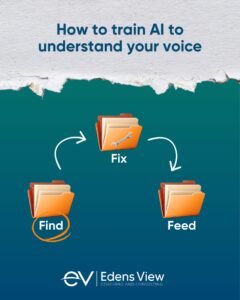
Find: Locate examples of your authentic voice. For me, this meant articles and transcripts I’d written without AI assistance. Sermons. Handwritten content. Anything that sounded unmistakably like me, because it was me.
Feed: Give those examples to the AI. Have it analyze them. Ask it: What patterns do you see? What makes this voice distinctive? What would be missing if someone else wrote this?
Fix: Compare the AI’s output to your authentic voice. Where does it miss? What sounds generic? What sounds like “AI slop” instead of you? Update your voice guide based on the gaps.
Then repeat. And repeat again.
I estimate 20-25 hours of this iterative work before the AI reached 90% of my voice.
And I still hand-polish the last 10%.
Does that sound like a lot? Consider the alternative: every piece of content feeling slightly off, slightly generic, slightly not-you. Or spending hours without AI, painstakingly starting with a blank page; editing; proofreading; source attribution. The hours you invest in training pay dividends on everything you create afterward.
What’s worth 20 hours of focused work if it transforms how you create everything that follows?
Why Your Disappointment Makes Sense
Looking back: the reason I got generic output wasn’t because AI doesn’t work. It was because I put generic input in. As I frame it for clients: “Generic in, generic out.”
Most people try AI for content, get disappointing results, and conclude AI isn’t ready. But that’s like concluding your oven doesn’t work because your cake came out flat; you never gave it a recipe.
What’s the recipe? Context. Your voice. Your frameworks. Your actual expertise. Your real stories with real clients.
Without that, AI has nothing to work with except patterns from everyone else. Of course it sounds generic. It’s averaging the internet. Why would it sound like you when you haven’t taught it who you are?
The Foundation Comes First
Looking back: my decades of sermon writing weren’t a liability. They were the asset.
The six months of handwritten content weren’t wasted. They became training data.
The coaching patterns I’d developed over years weren’t replaced by AI. They were extracted, made visible, and systematized.
AI accelerated what I’d already built. It didn’t substitute for it. Foundation first. Acceleration second.
If you’re a leader with years of experience, why is this good news? Because you have something most people trying AI don’t have: a foundation worth accelerating.
The question isn’t whether to use AI. The question is whether you’re willing to invest the time to teach it who you are.
Are you?
Questions to Consider
- What expertise do you have that AI could help you extract and systematize?
- Where are you putting “generic in” and wondering why you’re getting “generic out”?
- What would it look like to invest 20 hours in teaching AI your voice; knowing you’d still polish the last 10%?
- What examples of your authentic voice could you start collecting today?
- Who in your network might already be a level ahead; waiting for you to ask?
Continue the Conversation
If you’re a business leader wrestling with how to approach AI wisely, you already have the foundation. Now let’s talk about acceleration.
I’m hosting a free webinar with Max Bernstein: AI for Leaders Who Want to Stay Human.
Max will share his expertise on AI integration: the same methods that transformed how I work. We’re now partnering to help leaders get confident clarity on AI, combining Max’s AI consulting with my coaching. For current clients, this is available as an add-on. For new clients, it’s an integrated package.
No hype. No fear. Just practical wisdom for leaders who want to engage thoughtfully.
I’ll see you there.
David Limiero is the founder of Edens View Coaching and Consulting, helping overwhelmed leaders move from overwhelm to overflow.